


Advanced Molecular Docking & Simulation Course
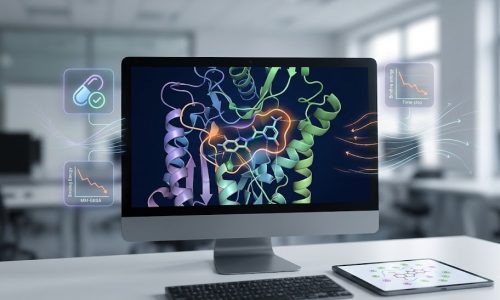
Advanced CADD & Molecular Dynamics Masterclass
Offered by Global South Varsity
Computer-Aided Drug Design (CADD) requires a multi-faceted approach to validate lead compounds. This intensive hands-on course provides exclusive training on the industry-standard Schrödinger Maestro suite. Participants will master the complete computational workflow: mining structural databases, executing precise docking protocols, predicting ADME properties, calculating binding free energy, and running rigorous molecular dynamics (MD) simulations.
Who Should Attend?
- Undergraduate Students: Transition from textbook molecular biology to practical bioinformatics and structural modeling.
- Postgraduate Students: Enhance your computational chemistry toolkit to validate experimental findings in your research.
- Early Career Researchers: Gain a competitive edge by mastering commercial, industry-grade software for drug discovery.
Course Curriculum
Note: This course focuses heavily on hands-on software execution using the Schrödinger suite
Module 1: Bioinformatics Databases & Target Selection
- Navigating structural databases (RCSB PDB, UniProt).
- Identifying and downloading the highest resolution PDBs for reliable computational modeling.
- Exploring chemical databases (PubChem, ZINC) for small molecule libraries.
- Understanding 2D formats (SMILES) and converting them for 3D analysis.
Module 2: Preparation & ADME Profiling (QikProp)
- Using the Protein Preparation Wizard: adding hydrogens, optimizing H-bond networks, and energy minimization.
- Ligand preparation via LigPrep: generating stereoisomers, tautomers, and correctly identifying specific protonation states (e.g., resolving monocationic vs. dicationic forms).
- Predicting pharmacokinetic properties and drug-likeness using QikProp (ADME).
Module 3: Receptor Grids & Molecular Docking (Glide)
- Defining the active site and executing Receptor Grid Generation.
- Running Glide (Grid-Based Ligand Docking with Energetics).
- Mastering Standard Precision (SP) docking methodologies and setting appropriate constraints for small molecules.
- Visualizing 2D and 3D ligand-receptor interaction diagrams.
Module 4: Binding Free Energy (MM-GBSA) & Case Studies
- Validating docking scores by calculating binding free energy using Prime MM-GBSA.
- Interpreting energetic contributions to ligand binding.
- Practical case studies focusing on complex systems like targeted protein degradation (molecular glues) and specific parasitic targets (e.g., PfDegP, SERA5, Falcilysin).
Module 5: Molecular Dynamics (MD) Simulations (Desmond)
- Introduction to MD principles and the Desmond simulation environment.
- System Builder setup: solvating the protein-ligand complex with explicit water models and adding neutralizing ions.
- Running the simulation trajectory and analyzing post-run data (RMSD, RMSF, and protein-ligand contacts).
- Exporting high-quality, publication-ready graphics and trajectory movies.
⚠️ Important Note: Bring Your Own Device (BYOD)
All participants are required to bring their own laptops to ensure they can retain the installed software configurations and practice independently after the course. Please ensure your system meets the following minimum requirements to run the Schrödinger Maestro suite smoothly:
- Windows: Windows 10 or 11 (64-bit).
- macOS: macOS 12 (Monterey) or newer (fully compatible with Intel and Apple Silicon M-series).
- Linux: Ubuntu 22.04 LTS or newer (including the latest 24.04 LTS releases).
- Hardware Specs: Minimum 8GB RAM (16GB highly recommended for MD simulations), multi-core processor (Intel Core i5 / AMD Ryzen 5 or higher), and at least 50GB of free storage space.
- Peripherals: A physical 3-button mouse with a scroll wheel is strictly required. Manipulating 3D protein structures using a laptop trackpad is highly inefficient.
Summer 2026 Batch
📅 June 05 – 09, 2026
⏰ 11:00 AM Onwards
Enrollment Closed
Course Enrollment Process:
Enrollment is only considered complete once the payment has been successfully made and the payment confirmation screenshot is uploaded to your application.
- Fill in all required fields accurately on the enrollment form.
- All are requested to bring one copy each of their Institutional ID and Personal ID.
contact@globalsouthvarsity.org
Instructor

